News & Resources
Search
Login
Newsletter
8 Horizon Renewable Energy SPARKlabs for Middle School and High School Students
Horizon Fuel Cell is a company dedicated to bring commercially viable, clean hydrogen fuel cell power to the public. Horizon's education kits are used to explain renewable energy science in a classroom environment. PASCO has partnered with Horizon to offer SPARKlabs on renewable energy for both middle school and high schools.
Created in partnership with Horizon Fuel Cell Technologies, these 8 SPARKlabs cover solar, wind and hydrogen fuel cell environmental science activities. Perform each lab using the materials included in the renewable energy kit along with the SPARK Science Learning System.
Designed to guide Middle School and High School students through the process of investigation and promote critical thinking and group discussion, these standards-based, teacher-designed SPARKlabs include:
- Background science content

- Setup guidance
- Seamless integration with data collection and analysis
- Embedded assessment and reflection prompts
The SPARKlabs contain the set of investigations and consists of a download folder with:
- 8 Lab Files for SPARK and SPARKvue
- Teacher Notes
- Read-me (Getting Started) Instructions
These labs are written in the form of a guided inquiry. Since the equipment will be new to the students, much of the labs are meant to familiarize the students with assembling and using the alternative energy equipment.
In each lab there is an extension which is is provided in each lab for a variety of purposes. If the students are ready to conduct their own inquiry, the extension can provide ideas for their inquiry question. If some students finish early, the extension can give them a further related idea to explore. The Extension could also serve as extra credit or reinforcement. In most cases, the data collection graphs, tables or displays in the lab can be used to collect data for the Extension. The students can also build a page containing a graph, or add a page to write observations.
Answers to the Analyze Data, Analysis or Synthesis questions, along with screen shots of the graphical displays of the data and related slides, are provided in the Teacher Notes for each lab. The answer to the Driving Question is also found in the Teacher Notes. You can have your students turn in their electronic journal after they have taken snapshots of their pages: they can print their journal, save it to a USB and transfer it electronically, or save the entire lab by giving it a new name. Additionally, you can add your own assessment questions to the lab.
- The effect of tilt angle on a solar panel
In this SPARKlab activity, students will learn from their own collected data that the more directly that sunlight strikes the solar cell, the greater the voltage output. The setup is simple and can be done indoors (with lamps) or outdoors under sunlight.
- The effect of heat on a solar panel
In this SPARKlab activity students investigate how the voltage changes when a solar panel heats up under a lamp or in sunlight.

- The effect of shade on a solar panel
In this SPARKlab activity students collect data and decide how shade impact energy production on a solar panel.
- Altering the pitch of blades in a wind turbine.
In this SPARKlab activity students vary the pitch of blades with the same surface area to see the impact on the energy produced. Students can infer the best design for high and low wind conditions.
- Altering the number of blades in a wind turbine
In this SPARKlab activity students vary the number of blades to with similar length to see how it what is the most efficient design in high and low wind conditions.
- Altering the length of blades in a wind turbine
In this SPARKlab activity students change the surface area of a blade by testing blades of different length. Are Six blades better than three?
- Compare the voltage output of a fuel cell versus a battery
In this SPARKlab activity students generate hydrogen from water and then use it for energy production. Then, they compare this energy production to that energy produced by a battery.
- Voltage required for water decomposition
In this SPARKlab activity students use a battery and a solar cell to dissociate water into hydrogen and oxygen.
These labs are written in two parts. Part 1 contains a guided inquiry intended to introduce the students to the use of the equipment and to the concept to be tested. Part 2 is intended to be an inquiry designed by the students and conducted on a related question to Part 1. The Conclusion is addressed after the students have completed their own inquiry in Part 2 because they are given the opportunity to answer their own related questions in order to fully understand the driving question for the lab. Therefore, the student inquiry is an integral part of the lab and not intended to be optional.
Not all inquiries are driven by testable questions; some are research questions, and some inquiries explore the function of an apparatus. In the Horizon Alternative Energy SPARKlabs, the inquiries will be extensions of the guided part of the lab, and will begin with testable questions designed by the students.
It is recommended that you reserve a place in the classroom where students can post questions related to the guided inquiry being conducted as they come up. These questions can be in any form and do not have to be testable at first. When the guided inquiry portion of this lab has been completed, a survey of these and other related questions can be conducted, and those questions which are or could be testable can be identified.
After having completed the guided inquiry (Part 1) and their own inquiry (Part 2), students are ready to conclude their work. They will answer the driving question from the guided portion of the lab, and address their own driving question, since these questions are related.
Answers to the questions posed in Part 1, along with screen shots of the graphical displays of the data and related slides, are provided in the Teacher Notes for each lab. Additionally, you may want to evaluate the way students conducted their own inquiry. A rubric is provided that can serve as a starting point for evaluating student inquiries. You can amend it as needed to suit your assessment needs.

- The effect of tilt angle on a solar panel
In this SPARKlab activity, students will learn from their own collected data that the more directly that sunlight strikes the solar cell, the greater the voltage output. The setup is simple and can be done indoors (with lamps) or outdoors under sunlight.
- The effect of heat on a solar panel
In this SPARKlab activity students investigate how the voltage changes when a solar panel heats up under a lamp or in sunlight.
- The effect of shade on a solar panel
In this SPARKlab activity students collect data and decide how shade impacts energy production on a solar panel.
- Altering the pitch of blades in a wind turbine
In this SPARKlab activity students vary the pitch of blades with the same surface area to see the impact on the energy produced. Students can infer the best design for high and low wind conditions.
- Altering the number of blades in a wind turbine
In this SPARKlab activity students vary the number of blades to with similar length to see how it what is the most efficient design in high and low wind conditions.
- Altering the length of blades in a wind turbine
In this SPARKlab activity students change the surface area of a blade by testing blades of different length. Are Six blades better than three?
- Compare the voltage output of a fuel cell versus a battery
In this SPARKlab activity students generate hydrogen from water and then use it for energy production. Then, they compare this energy production to that energy produced by a battery.
- Voltage required for water decomposition
In this SPARKlab activity students use a battery and a solar cell to dissociate water into hydrogen and oxygen.
Horizon SPARKlab Screenshots |
|||
|
|
![]() |
||
|
|
||
![]() |
![]() |
||
|
|
||
![]() |
![]() |
||
|
|
||
![]() |
![]() |
||
|
|
||
![]() |
|||
|
*These screenshots are all from Altering the Number of Blades in a Wind Turbine which is designed to show students the most efficient design in high and low wind conditions.
Purchase Middle School Horizon Renewable Energy SPARKlabs
Horizon Renewable Energy SPARKlabs for Middle School (PS-2856)
Connect middle school students to a world where clean energy is essential through Horizon Renewable Energy SPARKlab activities.
Or the High School Horizon Renewable Energy SPARKlabs
Horizon Renewable Energy SPARKlabs for High School (PS-2857)
And the Horizon Renewable Energy Kit
Horizon Renewable Energy Kit (SE-7238)
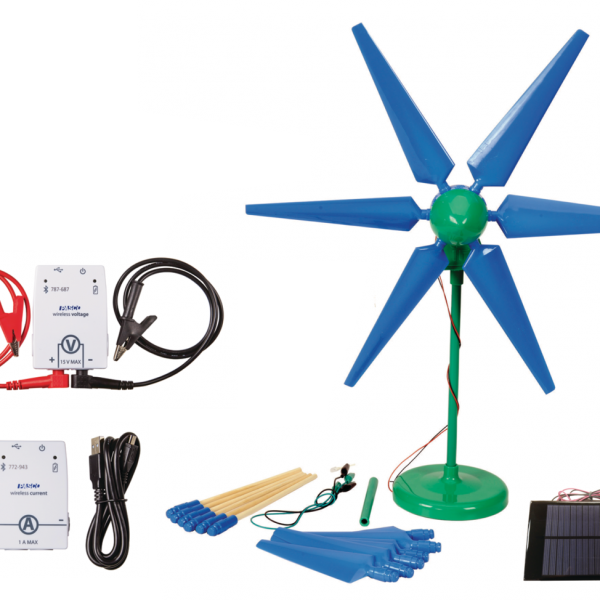
Perform the 8 SPARKlab Activities in the Horizon SPARKlab series with the Horizon Renewable Energy Kit.
Includes:
- 1 W Solar Cell (SE-8847)
- Wind Turbine
- Long Curved Blades (3 sets of different curvatures)
- Long Flat Blades
- Short Flat Blades
- Reversible Fuel Cell Module
- Gas/Water Storage Module
- Small Motor with Propeller
- AA Battery Pack
- Pair of Banana Plug Cables
Choose the data collection solution for your classroom
(Option 1) the SPARK Science Learning System
SPARK Science Learning System (PS-2008A)
An all-in-one mobile device that seamlessly integrates the power of probeware with inquiry-based content.

(Option 2) SPARKvue Software and a SPARKlink
SPARKvue Site License (PS-2400)
SPARKvue software combines multimedia curriculum, real-time data collection, and powerful scientific analysis tools in an easy-to-use, icon-based user interface.
SPARKlink (PS-2009)
SPARKlink is a sensor interface with two ports to accept PASPORT sensors and USB connection to a computer running SPARKvue software. Built in temperature and voltage sensors allow for measurements right out of the box.